Published: August 2026 | Reading Time: 6 minutes
By Macdee Hlalele — Founder, ApplyOnlineSA
The single biggest factor determining which school your child gets placed at in Gauteng is something most parents barely understand — the feeder zone.
If you do not understand how feeder zones work, you could apply to all the wrong schools and end up with no placement — or a placement far from home. This guide explains everything.
What is a Feeder Zone?
A feeder zone — also called a school catchment area — is a specific geographic area surrounding a school from which the school gives priority admission.
Think of it like a delivery zone. If you live inside the delivery zone, you get served first. If you live outside it, you might still get served — but only if there is capacity left after everyone inside the zone has been accommodated.
The GDE uses feeder zones to ensure that:
- Children can attend schools close to their homes
- Schools serve their immediate communities
- Transport burdens on families are minimised
How Feeder Zones Affect Your Application
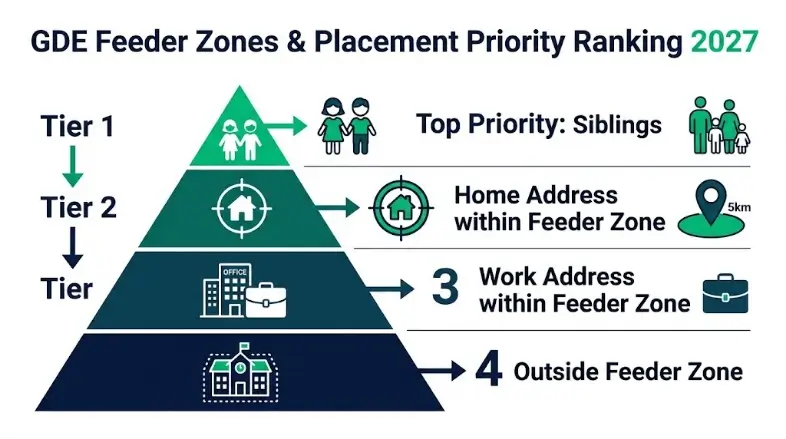
When the GDE processes admissions applications, children are prioritised in this order:
Priority 1 — Siblings
If your child has a brother or sister already enrolled at the school, they get first priority regardless of feeder zone.
Priority 2 — Feeder Zone Residents
Children whose home address falls within the school’s official feeder zone.
Priority 3 — Work Address
If a parent works within the school’s feeder zone (even if the family lives elsewhere), this can support an application.
Priority 4 — Outside Feeder Zone
Children from outside the feeder zone are only considered if spaces remain after all feeder zone applications have been processed.
How to Find Out If You Are in a School’s Feeder Zone
Method 1 — GDE Admissions Portal
When you search for schools on www.gdeadmissions.gov.za, the portal indicates whether your registered address falls within each school’s feeder zone.
Method 2 — Contact the School Directly
Call or visit the school and ask: “Is [your street address] within your feeder zone for 2027 admissions?”
Method 3 — GDE District Offices
Your nearest GDE District Education Office can confirm feeder zone boundaries for any school in Gauteng.
GDE Contact: 0800 000 789 (toll-free)
Important Feeder Zone Rules
Your address must match your documents
The address you enter on the portal must exactly match your proof of residence. The GDE verifies this. A mismatch will affect your placement priority.
Renting? Use your lease agreement
If you are renting, a lease agreement plus a recent rental payment receipt is accepted as proof of residence.
You cannot use someone else’s address
Using a relative’s address to fall within a preferred school’s feeder zone is fraudulent. The GDE cross-checks addresses and fraudulent applications are disqualified.
Feeder zones can change
Feeder zone boundaries are reviewed periodically by the GDE. Always confirm the current boundaries for the 2027 admissions cycle — do not assume they are the same as previous years.
What If Your Preferred School is Outside Your Feeder Zone?
You can still apply — but manage your expectations:
- Apply to your preferred out-of-zone school as school 4 or 5 on your list
- Prioritise in-zone schools as schools 1, 2, and 3
- Out-of-zone placement only happens if the school has remaining capacity after all in-zone applications are processed
- Popular schools in sought-after suburbs rarely have capacity left for out-of-zone learners
Feeder Zones for Grade 1 vs Grade 8
Grade 1 (Primary Schools)
Feeder zones for primary schools are generally smaller — covering the immediate surrounding neighbourhood. Most primary schools serve a specific suburb or section of a suburb.
Grade 8 (High Schools)
High school feeder zones are larger — typically covering the primary schools that traditionally feed into that high school. Your child’s current primary school is often an indicator of which high school feeder zone you fall into.
Ask your child’s current primary school: “Which high schools are in our feeder zone area?”
Frequently Asked Questions About Feeder Zones
Can I appeal if my application is rejected due to feeder zone?
Yes. If you believe your address was incorrectly categorised or your documents were misread, you can appeal through the GDE. Read our guide on what to do if your child is not placed →
What if I move after applying?
Contact the GDE immediately if your address changes after submission. Your placement priority may be affected.
Do private schools use feeder zones?
No. Feeder zones apply only to public schools funded by the GDE. Private schools set their own admission criteria.
Need Help Understanding Your Feeder Zone?
WhatsApp Macdee → | Book a Consultation →
Related Articles:
- How to Apply Online for Grade 1 and Grade 8 — GDE 2027 →
- GDE Admissions 2027 — What Happens After You Apply →
- What to Do if Your Child is Not Placed by GDE →
- Matric Resources — Everything Grade 12 Learners Need →
ApplyOnlineSA is independent and not affiliated with the GDE. Feeder zone information is for guidance only. Always verify at www.gdeadmissions.gov.za or by contacting the GDE directly.
Send Us a Message & Subscribe
Leave a note or feedback along with your email subscription!